Why the Version You Haven't Finished Yet Might Be the Truest Thing You've Ever Made

Somewhere between the first raw sketch and the final polished export, something gets lost. You can't always name it. It's not a lyric or a brushstroke or a chapter — it's more like a feeling. A wobble. A question mark that lived in the work before you answered it for the audience.
And lately, a growing number of artists are starting to wonder: what if that thing you smoothed over was actually the whole point?
The Myth of the Finished Product
We've been trained — by streaming platforms, gallery standards, publishing timelines, and the general anxiety of putting things online — to believe that done means good. That rough edges are a sign of laziness or inexperience. That if you ship something with loose threads, people will notice and judge you for it.
But here's the thing: they notice anyway. And increasingly, they're noticing in the best possible way.
Think about the songs that hit you hardest. Are they always the ones with the pristine production and the perfectly resolved bridge? Or are some of them the ones that crack a little in the chorus, that end on a note that doesn't quite settle, that feel like the singer hadn't fully worked something out yet and let you hear that in real time?
There's a reason people still talk about Elliott Smith's four-track recordings with more reverence than a lot of major-label releases. There's a reason Basquiat's deliberately unfinished canvases — with their crossed-out words and exposed underlayers — feel more alive than a lot of technically "complete" paintings hanging in the same museums.
Incompleteness, it turns out, is its own kind of language.
What Gets Stripped Away in the Polish
The editing process is supposed to serve the work. And it often does. But it can also become a place where artists unconsciously sand down the things that make them vulnerable.
You record a vocal take that cracks on the high note. You fix it. You write a paragraph that's a little too honest about how confused you are about something. You rewrite it into something more confident. You paint a section that looks uncertain — like your hand wasn't sure where to go — and you go back over it.
None of those individual decisions feel like a big deal. But add them up across an entire piece, and what you sometimes end up with is work that's technically accomplished and emotionally sealed. It doesn't let anyone in because you've already resolved every tension before the audience gets there.
Creators who've started pushing back against this describe it as the difference between showing your thinking and showing your conclusions. Audiences are hungry for the former, even when they can't articulate why.
The Artists Leaving Things Open on Purpose
This isn't just a theory. Across music, visual art, and storytelling, there's a real and intentional movement toward strategic incompleteness.
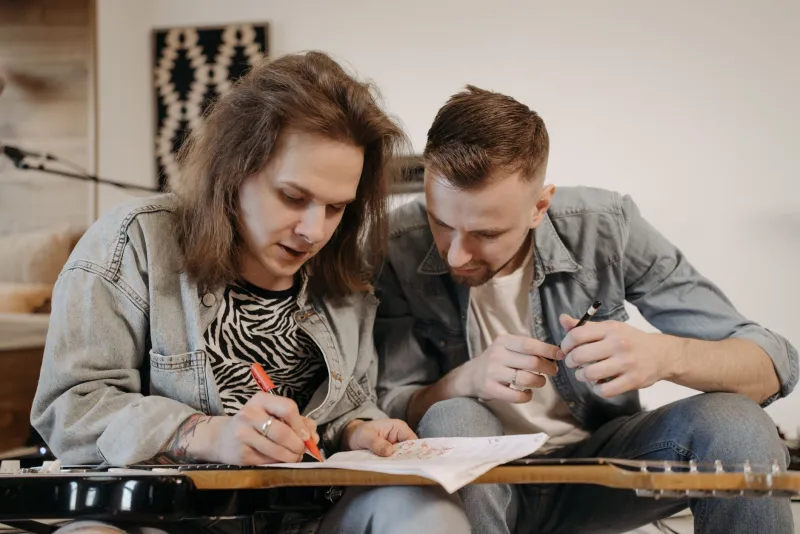
In the indie music world, artists are releasing "sketch versions" of songs alongside finished recordings — not as demos or B-sides, but as equal and sometimes preferred versions. The rough take where you can hear the room, where the arrangement hasn't been decided yet, where the emotion is still wet. Listeners aren't treating these as lesser. They're treating them as more intimate.
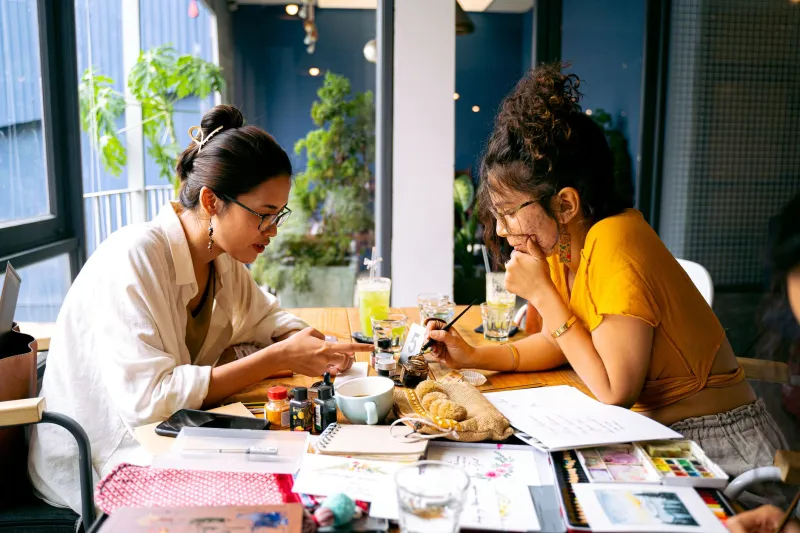
Visual artists are posting process work — not just as content fodder, but as the actual art. The half-finished canvas. The painting that got abandoned two-thirds of the way through because something else became more interesting. Some of these "incomplete" pieces are selling faster and generating more conversation than their finished counterparts.
Writers are experimenting with essays and stories that don't tie up their own threads. That ask questions they don't answer. That end mid-thought because that's where the honest version of the story actually ends.
What all of these approaches have in common is a refusal to protect the audience from the artist's uncertainty. And that refusal feels, right now, like a form of respect.
Why Audiences Are Responding
We're living through a particular cultural moment where trust in polished things is low. Highly produced content, carefully managed personal brands, algorithmically optimized everything — people are exhausted by surfaces that never crack. They're craving proof that something real is happening underneath.
When a piece of art admits its own uncertainty — when it leaves a gap where a gap genuinely exists — it gives the audience somewhere to stand. It says: I haven't figured this out, and neither have you, and maybe that's what we have in common right now.
That's not weakness. That's an invitation.
There's also something about the incompleteness that activates the audience's own imagination. A resolved piece delivers an experience. An unresolved piece creates a collaboration. You bring your own interpretation to the loose thread and pull it in whatever direction your life has prepared you to pull it.
Some of the most discussed, most shared, most emotionally resonant work right now operates exactly this way.
The Difference Between Unfinished and Lazy
It's worth being honest about the distinction, because it matters. Leaving something unresolved on purpose is a creative choice. Releasing something underdeveloped because you ran out of energy or patience is a different thing entirely, and audiences can usually tell.
Intentional incompleteness has a quality to it. It feels considered. The gaps are in service of something — a feeling, an idea, a question the artist wants to hold open. The work around those gaps is strong enough to hold them.
Laziness has a different texture. The incompleteness feels accidental, like the artist didn't notice or didn't care. There's no tension being held — just absence.
The artists doing this well are often more disciplined than their polished counterparts, not less. They have to be rigorous about which uncertainties to preserve and which ones to resolve, because not every loose thread deserves to stay loose.
What This Means for Your Own Work
If you've got something sitting in your drafts right now that you keep almost finishing — it might be worth asking what's actually stopping you. Is it genuinely not ready? Or have you already said the truest version of what you wanted to say, and now you're just filling in the blanks to make it feel "complete"?
Sometimes the almost-done version is the done version. Sometimes the crack in the vocal, the unresolved ending, the visible seam in the composition — that's not a flaw you haven't gotten around to fixing. That's the thing.
The pressure to deliver polished work is real, and it's not going anywhere. But the permission to leave things open — to trust your audience with your uncertainty — that's real too. And right now, it might be the more interesting creative risk to take.
Your finished work shows what you know. Your unfinished work shows what you're still figuring out. And for a lot of people, the second one is the one they actually needed to see.