Stop Waiting Until You're Ready: The Case for Messy, Honest Creative Work
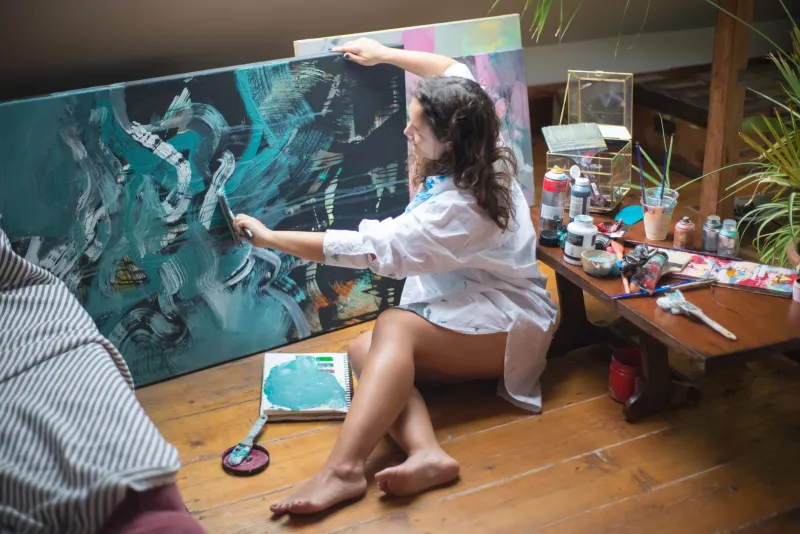
Let me paint you a picture. You've been working on something — a song, a painting, a short story, a collection of poems — for months. Maybe longer. It's gotten better. You've revised it, refined it, second-guessed it at 2am more times than you can count. And every time you get close to sharing it, something stops you. It's not quite right yet. The production isn't polished enough. The brushwork is too visible. You haven't figured out the ending.
So you wait.
Meanwhile, someone else posts something raw and unfinished and deeply personal, and it completely breaks people open. The comments are full of "this is exactly how I feel" and "I needed this today." And you think: how?
Here's the uncomfortable truth that a lot of creative advice dances around: the waiting isn't protecting your work. It's protecting you.
Perfection Is a Feeling, Not a Standard
The thing about "not ready yet" is that it's almost never a technical assessment. It's an emotional one. The work might genuinely need more development — that happens. But more often, "not ready" means "I'm scared of what happens when people see this."
And that fear makes total sense. Sharing creative work is genuinely vulnerable. You made something from nothing, from the inside of your own head and heart, and now you're asking other people to look at it and have feelings about it. That's not nothing.
But here's what's interesting: the polishing process we use to manage that fear often sands down the very thing that made the work worth sharing. The rough edge that felt "unprofessional" might have been the emotional hook. The lyric that felt "too obvious" might have been the one that lands. We edit out our own voice in the process of trying to make something sound more like what we think art is supposed to sound like.
The Artists Who Got Famous by Getting Real
This isn't just a theory. There are case studies everywhere you look.
Consider Taylor Swift's folklore — an album made in quarantine, quickly, with a collaborator she'd never met in person, released with almost no promotional buildup. No elaborate rollout, no single-a-month strategy, no carefully managed aesthetic era. Just: here's a thing we made, it's kind of quiet and weird, hope you like it. It became one of the most critically acclaimed albums of her career and connected with listeners in a way her more produced, more "polished" work sometimes hadn't.
Or look at what happened when Olivia Rodrigo released SOUR. The songwriting was raw to the point of being almost uncomfortable — specific, diary-entry honest, not trying to be universal. And precisely because it wasn't trying to be universal, it became universal. When you're that specific about your own experience, something strange happens: other people recognize themselves in it.
On the visual art side, artists like Jean-Michel Basquiat built entire aesthetic languages out of deliberate roughness. The crossed-out words, the unfinished figures, the visible marks of process — these weren't mistakes left in. They were the work.
The Psychology of Why Imperfect Art Hits Different
There's actual research behind this. Psychologists have a name for it: the pratfall effect. In social psychology, it describes how a person (or thing) that shows some vulnerability or imperfection is often perceived as more likable and trustworthy than one that presents as flawless. The small mistake, the visible seam, the moment of uncertainty — these signal authenticity in a way that seamlessness can't.
Applied to creative work, this means the thing you're most embarrassed about in your art might be precisely what creates connection. The shaky vocal take you almost re-recorded. The line that felt too personal. The painting that didn't turn out the way you planned but has something alive in it anyway.
Audiences — especially right now — are extraordinarily sensitive to the difference between work that's trying to impress them and work that's trying to reach them. After years of algorithmically optimized content and heavily filtered social media aesthetics, people are hungry for something that feels real. Something made by an actual human who was actually feeling something when they made it.
What "Authentic" Actually Means (It's Not What Instagram Told You)
The word "authentic" has been so thoroughly co-opted by marketing that it's almost lost its meaning. "Authentic" content is now a genre of its own — carefully produced to look spontaneous, strategically vulnerable in ways that have been A/B tested for engagement.
That's not what we're talking about here.
Real creative authenticity is less about aesthetic choices and more about honesty of intention. It means making the work that you actually need to make, not the work you think will be received well. It means including the part that scares you instead of cutting it for safety. It means being willing to be misunderstood by some people in order to be genuinely understood by others.
This is hard. It requires a specific kind of courage that has nothing to do with bravado and everything to do with showing up on the page, or the canvas, or the recording — and being honest even when that honesty is uncomfortable.
Practical Stuff: How to Actually Start Sharing
If you're sitting on work that you haven't shared because it doesn't feel ready, here are a few things worth considering:
Set a release condition, not a quality threshold. Instead of "I'll share it when it's good enough," try "I'll share it when I've revised it three times" or "I'll share it by the end of the month." Concrete conditions are finishable. Quality thresholds are not.
Find a small, trusted audience first. You don't have to post to the world. Share with two or three people whose opinions you trust and who will tell you the truth. Getting real feedback — not just internal anxiety — often breaks the paralysis.
Separate the work from the reception. You can't control how people respond to your art. You can only control whether you make it honestly and share it with intention. Tying your sense of the work's value to how it's received is a recipe for never sharing anything.
Remember that done is a form of respect. Finishing work and putting it into the world — even imperfect work — is how you honor the creative impulse that started it. Sitting on something forever isn't protecting it. It's keeping it from becoming what it could be.
The work you're waiting to perfect? Someone out there needs it right now, exactly as it is. That's not a reason to stop caring about craft. It's a reason to stop using craft as an excuse.
Make the thing. Share the thing. See what happens.